01
Positive feedback
Rating 5 · clear positive comment
CompletedNo review required
CUSTOMER FEEDBACK · ZAPIER
Helps teams sort customer feedback and identify which comments need attention first.
I built a Zapier workflow that saves customer comments, organizes them with AI, and flags low ratings or unclear feedback for review. I tested it using fictional submissions.
CURRENT EVIDENCE
Three controlled cases validated positive feedback, low-rating review, and uncertainty review. A fourth submission was confirmed to process automatically after publication. Original record preservation and the review/status formulas were checked.
Claim boundary: A validated prototype using fictional feedback, not a customer deployment. No measured time savings, sustained production reliability, trend analysis, automated failure recovery, or business ROI is claimed.
THE PROBLEM
A service business can receive a good rating alongside a complaint—or a low rating with little explanation. Someone still has to read the comment, understand what it means, and decide whether it needs a closer look.
I built this small Zapier prototype to test how much of that first pass could be organized while keeping the original feedback and the decision rules clear.
02 · HOW I BUILT IT
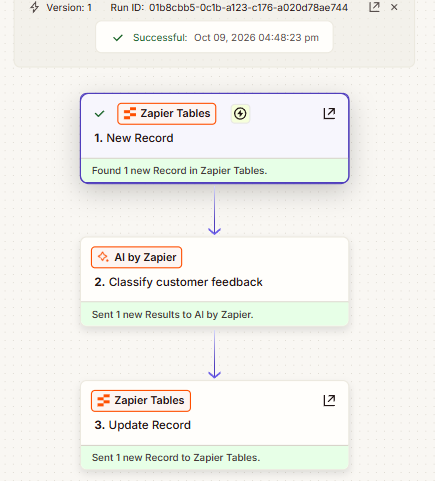
The form writes directly to the table. The Zap then reads, classifies and updates that same record. No separate intake Zap was needed.
The form saves the rating, category and original comment.
AI identifies the tone, main topic, summary and likely priority.
Zapier updates the same feedback record—not a duplicate.
Table rules flag low ratings or uncertain results for review.
Built with Zapier Forms · Zapier Tables · AI by Zapier
WHERE I KEPT CONTROL
AI returns the sentiment, main topic, short summary, suggested priority and whether the feedback is too unclear to classify confidently. It does not get to rewrite the customer's rating or original comment.
That check happens in the table, independently of AI's suggested priority.
A second table formula shows whether the result is Unprocessed, Completed, or Needs Review. If an AI step fails before saving a result, Zap history—not the table—must be checked for the failure.
04 · WHAT I TESTED
I checked opposite cases, not only a happy path. All examples below used fictional feedback.
Rating 5 · clear positive comment
Rating 2 · AI confident
Rating 4 · AI uncertain
New fictional submission
The initial AI test couldn't read the input. The record update was missing the correct ID. Later, an unmapped true/false value made an uncertain comment look complete. I corrected each mapping and retested the affected case.
05 · IMPLEMENTATION EVIDENCE
The actual workflow and a successful controlled test using fictional feedback. The test image is not evidence of an unattended live run.
Select an image to inspect · Zoom and pan available

WHAT THIS PROVES
In four tests with fictional feedback, the workflow classified comments and saved the results to the original records. Low ratings and uncertain classifications were flagged for review. After publication, a new submission was processed automatically.
Real customer adoption, time saved, measured business results, high-volume reliability, trend reporting, or automatic recovery from failed AI runs.
The implementation work was in the details: keeping the original input intact, separating AI classification from review rules, and correcting the failures the tests exposed.