Documents, records, project facts, or other approved sources that may contain information another system needs.
KNOWLEDGE OPERATIONS
Evidence-Grounded Organizational Knowledge System
Keeps company information reviewed, traceable, and safe for AI and other business systems to use.
WORKING SYSTEMTESTED · RELEASE VERIFIED
I built EOKS so other business systems can use company information without losing where it came from, which version is current, who approved it, or who is allowed to see it. Information can be reviewed, made available, withdrawn, and found again without letting AI decide what is true.
CURRENT EVIDENCE
Designed: complete. Built: complete. Tested: complete. Delivered: not yet complete. Measured: not yet complete
I built, tested, released, and documented the reference system from source registration and version history through human review, approval, access control, information retrieval, withdrawal, audit, recovery, and live health monitoring. The rules-based validation passed 40 of 40 cases, the release lifecycle test passed, and authenticated health and recovery checks passed.
Claim boundary: This proves the reference implementation and its controls work in the tested environment. It does not prove enterprise scale, use across multiple organizations, live business outcomes, semantic search quality, or ROI.
EXECUTIVE SNAPSHOT
A controlled way for business systems to use approved company information.
EOKS keeps the source, version, approval, access rules, and history attached to the information before another workflow can use it.
Register the source, keep its version history, review the information, apply access rules, and keep later changes visible.
Approved information another system can use, with a clear record of where it came from and why it is available.
WHEN YOU WOULD USE IT
When several workflows need the same company information, but the business still needs control over what can be trusted.
WHAT EOKS DOES
It keeps company information organized, reviewed, and safe to reuse.
Records where the information came from and keeps old and new versions tied to the same source.
New information stays unavailable until the right person reviews it.
Checks who is asking, what they are allowed to use, and whether the information is still active before returning it.
Withdrawals, replacements, conflicts, retries, and failures remain visible instead of disappearing.
THE OPERATING PROBLEM
A search result is not the same thing as approved company information.
A company can connect documents to an AI workflow and still have a control problem. The workflow may find an old version, expose restricted information, use a source that was never approved, or keep using information after it should have been withdrawn.
I built EOKS around those controls rather than around search alone.
Why this matters
Finding information does not make it approved.
The business still needs to know where the information came from, who approved it, who can use it, and whether it is still valid.
WHEN INFORMATION CAN BE USED
Finding information does not automatically make it safe to use.
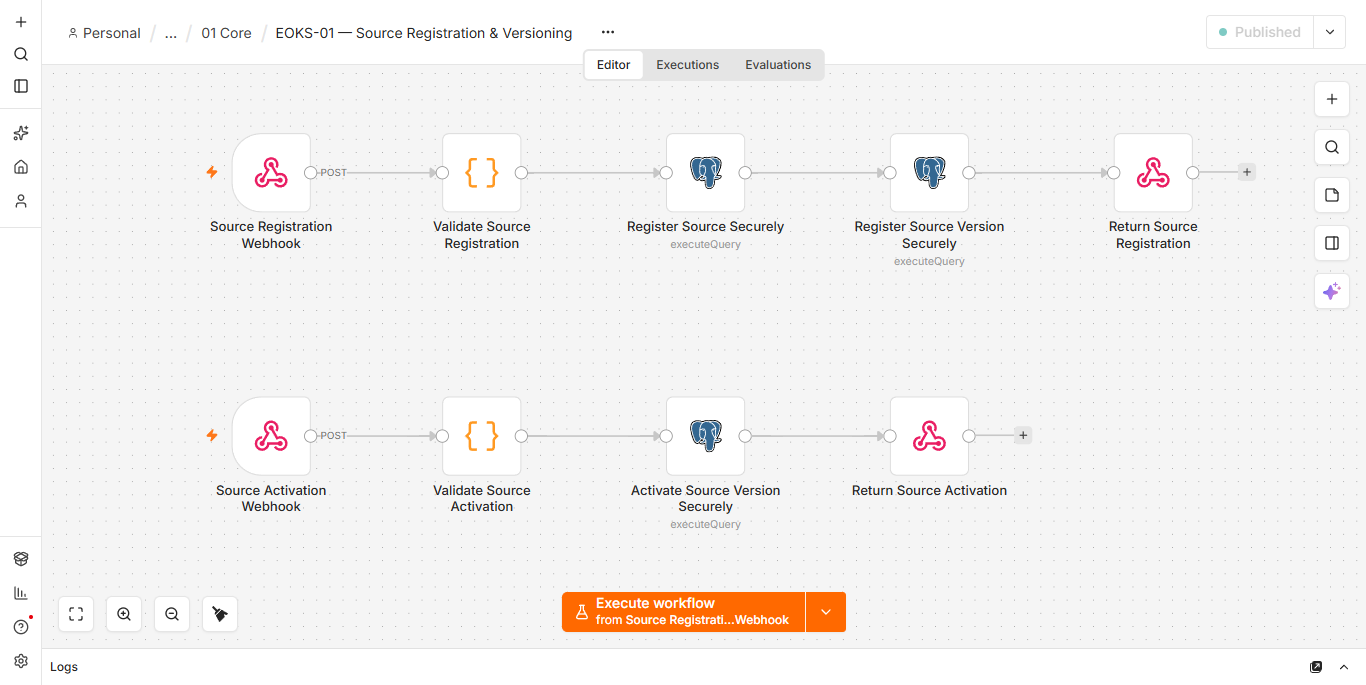
The n8n workflow registers the source and its version before any information can move toward review or use.
WHO CAN USE IT + WHO DECIDES
EOKS controls the information. It does not make the business decision.
Saving is not approval
Saving information does not automatically make it usable.
Source history stays intact
A new source version does not silently rewrite the old one.
Check access before showing anything
The system checks who is asking and what they are allowed to see.
Conflicts stay visible
Conflicting information is not silently resolved just to produce a clean answer.
Missing information is not a negative answer
NO_EVIDENCE means nothing usable was found, not that the statement is false.
AI cannot approve information
Gemini may help find a possible item, but a person controls approval and activation.
- Source identity and versions
- Information review and current status
- Who can see and use the information
- Controlled access and source history
- Audit, processing and recovery state
- Final business truth
- Whether the information answers a business requirement
- Proposal or fit decisions
- Decisions owned by another business system
- Automatic approval by AI
EGRS ↔ EOKS
EGRS was the first system connected to EOKS.
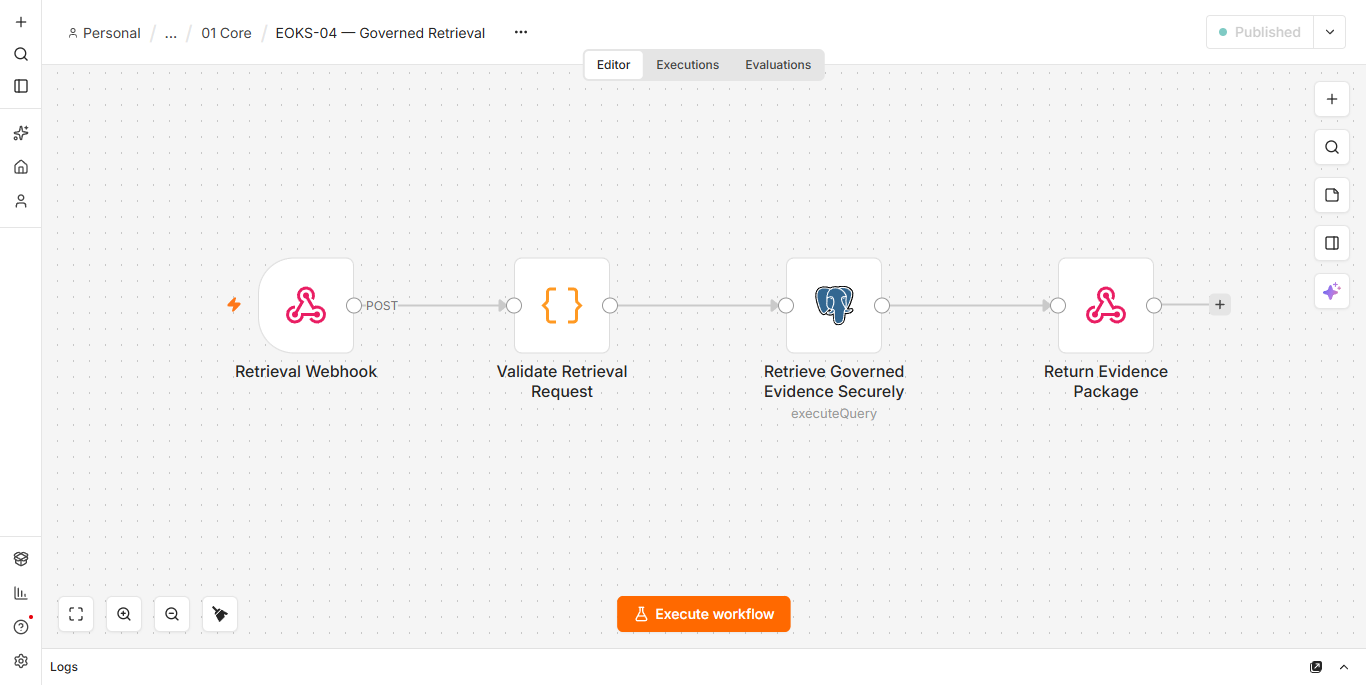
EGRS asks what approved company information is available for a question. EOKS checks whether EGRS is allowed to receive it and returns the information with its source history. EGRS then decides what that information actually supports.
What approved information is available for this question?
Check who is asking, what they can use, whether the information is active, and where it came from.
Decide what the returned information supports, partly supports, contradicts, or still cannot establish.
The workflow checks the requesting system, access rules, current status, and source history before returning anything.
AI BOUNDARY
AI can help find possible information. A person still decides whether it can be used.
Gemini can help find possible information in a source. It cannot make that information available for use, and a provider failure cannot skip the human review path.
- Finding possible information for review
- Reading source content
- Preparing something for a person to check
- Approval
- Making information available
- Withdrawing information
- Access rules
- Final company truth
OPERATIONS + RECOVERY
The system has to show when processing fails, not hide the failure behind a clean response.
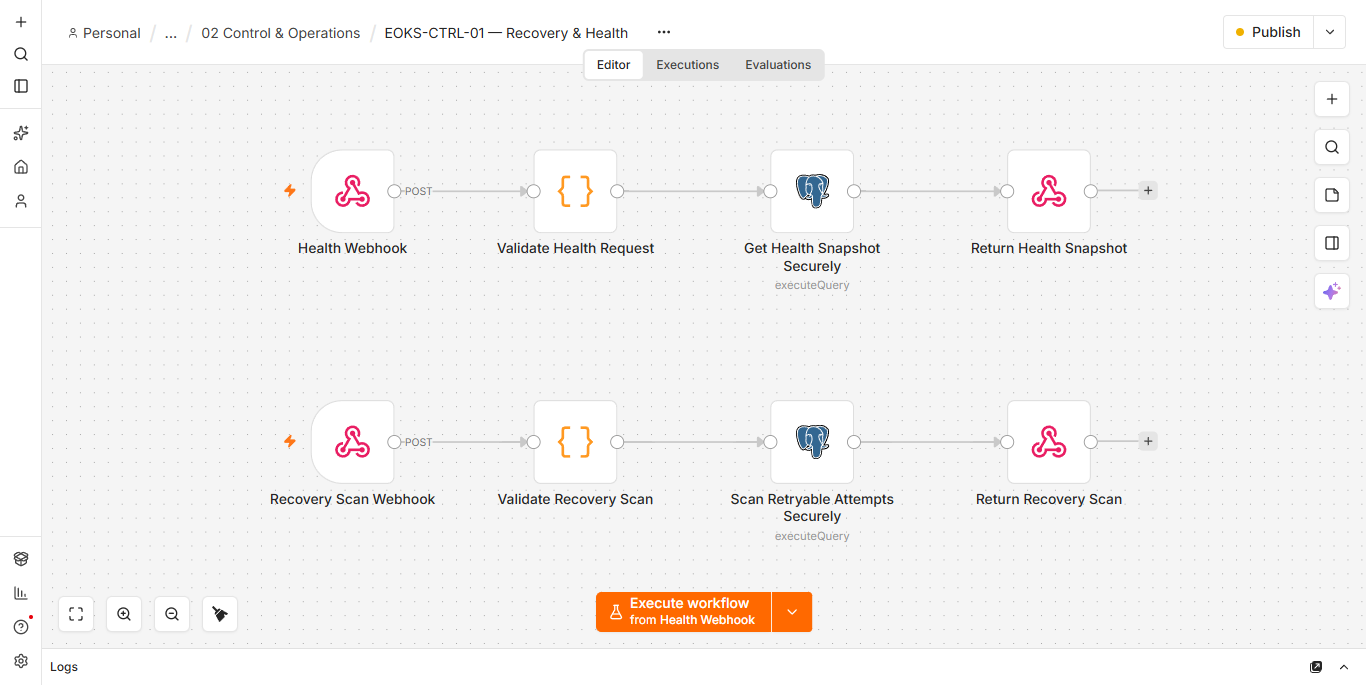
Failed workflow runs, errors that can be retried, search errors, pending reviews, and conflicts stay visible. In v1.0.1, old test history is kept out of live health and recovery counts so a clean system does not look unhealthy because of test data.
The authenticated health check passed after the health-monitoring fix.
No unresolved live retryable errors at the operating baseline.
Validation history remains available without polluting live health metrics.
The control workflow checks live health and retryable failures while keeping retained test history out of production counts.
VALIDATION
I tested the control rules, not just the happy path.
40 / 40 defined test cases
The isolated test run passed every defined case covering status changes, access, approval, information lookup, conflict, recovery, and audit behavior.
Withdrawn information stays out
The release test found the information while active and returned NO_EVIDENCE after it was withdrawn.
EGRS access check
EGRS received information through its assigned database identity rather than trusting an identity supplied in the request.
Unsafe paths stay blocked
Missing permissions, unclear access rules, invalid approvals, and AI-provider failures were tested without making information usable by mistake.
Clean live health metrics
v1.0.1 keeps retained test history out of live health and recovery counts.
Release + rollback records
The working release, workflow exports, checksums, runbook, change log, and rollback baseline are preserved.
ARTIFACTS TO INSPECT
The controls leave a record behind.
These examples summarize verified EOKS behavior. They contain no production secrets or private records.
REVIEWAPPROVED
CURRENT STATEWITHDRAWN
CAN IT BE USED?NO
FOUNDNO_EVIDENCERESTRICTEDSTALE_ONLYCONFLICTERROR
VALIDATIONPASS
RELEASE READINESSPASS
LIVE-PATH CHECKPASS
REFERENCE PATTERNVALIDATED
WHAT THIS PROVES
I can prove the system and its controls. I cannot claim scale or business results that have not happened.
EOKS v1.0.1 has been built, tested, released, and checked through its live path. I can show how its approval, access, information lookup, recovery, and monitoring controls behave. I cannot yet claim enterprise-scale use, broad adoption, measured savings, or ROI.
CURRENT EVOLUTION
The next proof has to come from real use over time.
EOKS v1.0.1 is released and operating in controlled use. Next: let real connected systems use it over time, watch whether it returns the right approved information and keeps the controls intact, and only add meaning-based search if real use shows exact wording is too limiting.
Need AI-assisted workflows that can use approved company information without losing control of it? Discuss a Project → ← View all selected work