A new lead or inquiry, plus the information needed to identify, qualify, and route it.
COMMERCIAL SYSTEMS
Lead-to-Client System
Helps a business keep leads from getting lost between inquiry, qualification, follow-up, sales, and client handoff.
WORKING SYSTEMRUNTIME TESTED
I built LCS to follow a lead from first inquiry to client handoff, keep the owner and next step clear, prevent missed or duplicate actions, and send uncertain decisions to a person instead of letting the workflow guess.
CURRENT EVIDENCE
Designed: complete. Built: complete. Tested: complete. Delivered: not yet complete. Measured: not yet complete
I built and runtime-tested the reference system from intake through qualification, follow-up, CRM handoff, human review, and recovery. The tests include real Gmail and HubSpot integration paths.
Claim boundary: This shows the reference system was designed, built, and runtime-tested. It does not prove live client results, long-term production performance, scale, or ROI.
EXECUTIVE SNAPSHOT
A system for moving a lead from first inquiry to client handoff without losing the next step.
LCS is for businesses where leads arrive from forms, email, referrals, or campaigns and then move through qualification, follow-up, sales, and onboarding.
LCS keeps the owner, status, next action, follow-up, and handoff clear as the lead moves through the journey.
A lead with a clear next step, recorded state, and controlled handoff—or a human review when the system should not decide alone.
WHEN YOU WOULD USE IT
When leads are coming in, but the journey between inquiry and client is hard to control.
WHAT LCS DOES
It keeps the lead journey moving with clear ownership and next actions.
Receive the lead and make sure the same inquiry is not handled twice.
Apply clear rules, use interpretation only when needed, and assign the right owner.
Keep the next action and date visible so viable leads do not disappear between conversations.
Move the result into the CRM or next team with the context and state needed to continue.
THE LEAD PROBLEM
A busy pipeline can still lose leads.
Lead problems are often blamed on the CRM, weak follow-up, or not having enough leads. Sometimes the real problem is simpler: no one clearly owns the next step, follow-up gets missed, or the handoff is incomplete.
I built LCS to follow the lead journey before deciding what should change.
Why this matters
A faster workflow is not automatically a more controlled one.
Automation helps only after the states, owners, next actions and exceptions are clear enough to automate safely.
MY ROLE
I designed how LCS finds the problem, then built the system that follows.
I defined how LCS checks the evidence, where a person still decides, and when a finding is strong enough to build from. Then I built and tested the lead workflow from intake through follow-up, CRM handoff, failure recovery, and audit.
HOW THE SYSTEM IS SET UP
Finding the problem and fixing it are two different steps.
Seeing a problem does not always tell me its cause. Even when I know the cause, a full rebuild may not be needed. I check each step before moving to the next one.
Field Guide + Lead Leakage Check
Lead-to-Client Snapshot
Clarify · Targeted Fix · LCS · Broader Review
Set the boundary · owners · rules · success conditions
Use only what the approved design needs
Test success · failure · recovery · regression
LEAD-TO-CLIENT PATHThe whole path is inspected even when the right fix is narrow.
WORKING IMPLEMENTATION
I did not stop at finding the problem. I built the controls it needed.
The Snapshot checks the evidence and keeps the final diagnosis with a person. The implementation turns the approved finding into a working system that I built and tested in a controlled environment.
The Snapshot reconstructs the journey, tests the evidence, and keeps final approval human.
Turn the approved finding into a clear implementation boundary without changing what the diagnosis said.
Move the lead through clear rules for identity, qualification, ownership, response, follow-up, conversion, and CRM handoff.
Keep system state reliable, make failures recoverable, and test the paths that can create duplicate or incorrect actions.
HOW THE WORKING SYSTEM FITS TOGETHER
One lead path with clear owners, decisions, and recovery.
The system follows the lead journey instead of forcing everything into one automation. I split it where the owner, state, outside service, or failure handling changes.
OPERATING JOURNEYOne controlled lead path
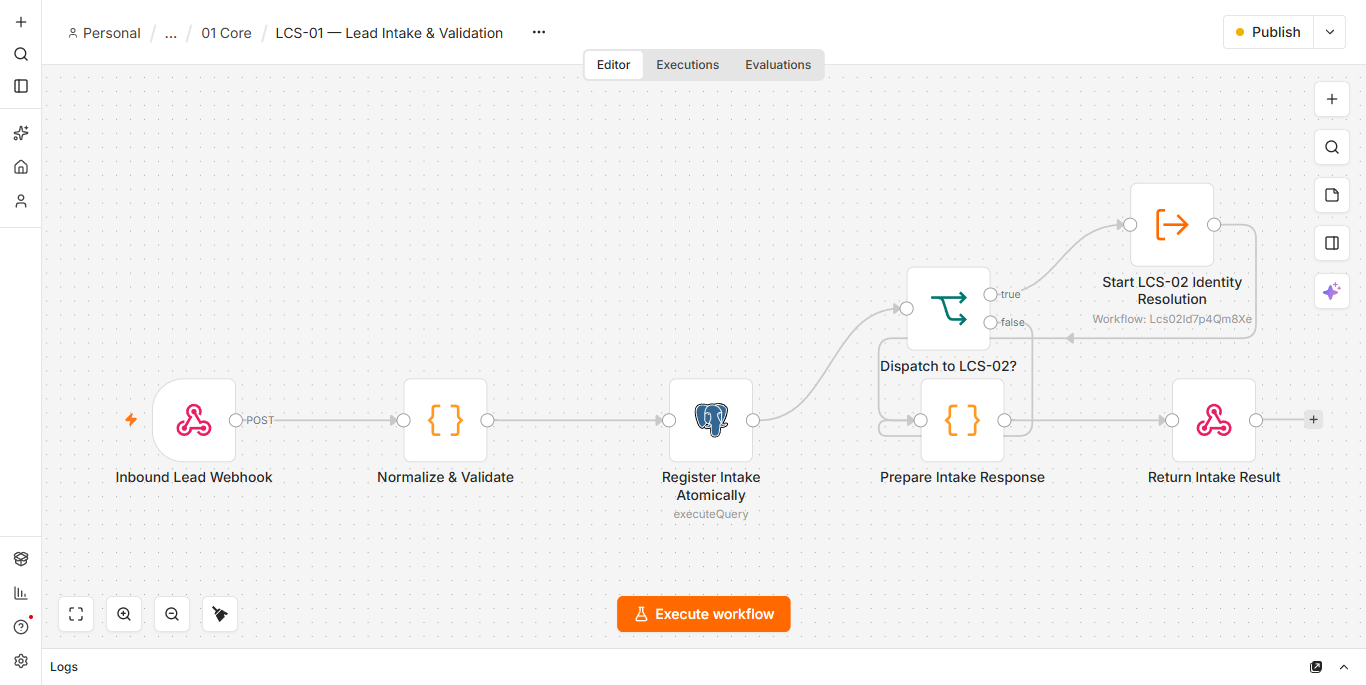
Validate → register → resolve identity
Apply rules → interpret when needed → route
Acknowledge → escalate judgment → keep human authority
Track engagement → SLA → next action
Synchronize outcome → contact → deal
Persistent state, audit history, and explicit recovery paths keep the journey traceable and recoverable.
INSIDE THE ACTUAL BUILD
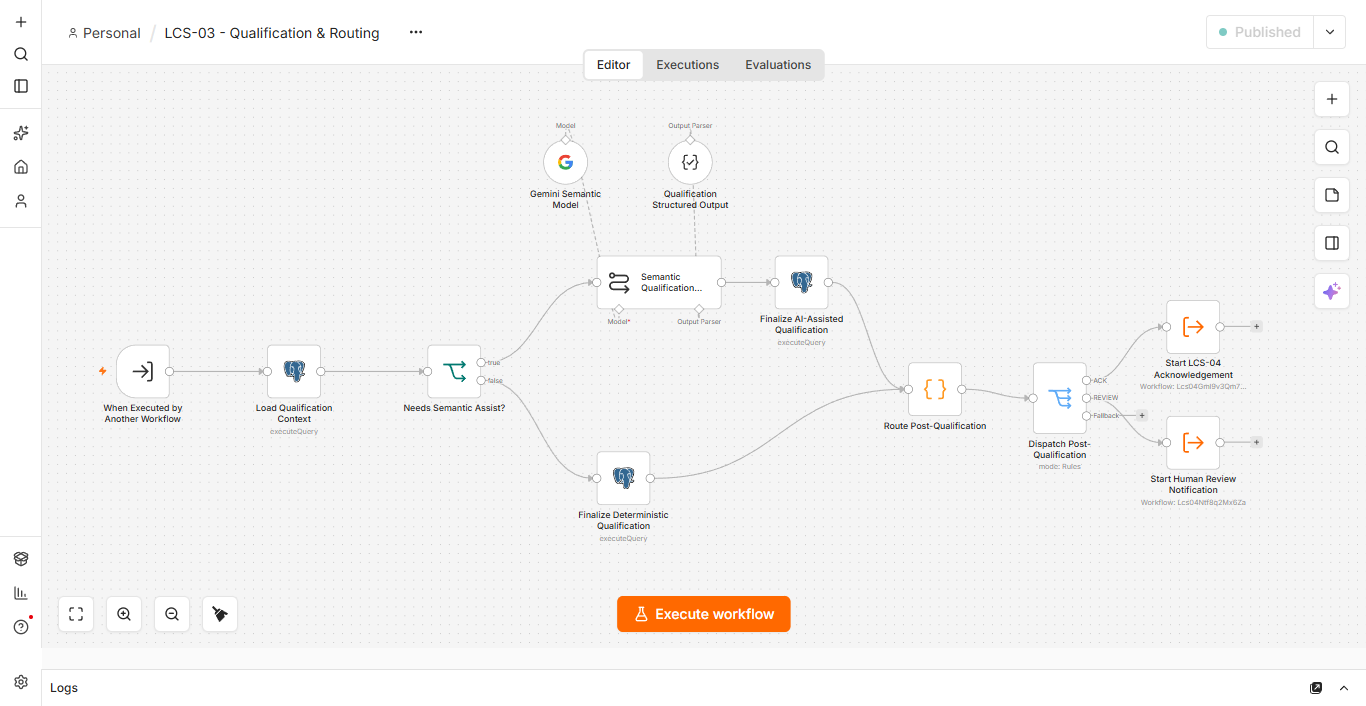
AI helps with interpretation, but it does not make the whole decision.
Clear cases follow fixed rules. When an inquiry needs interpretation, AI can help, then the workflow returns to clear routing rules or human review.
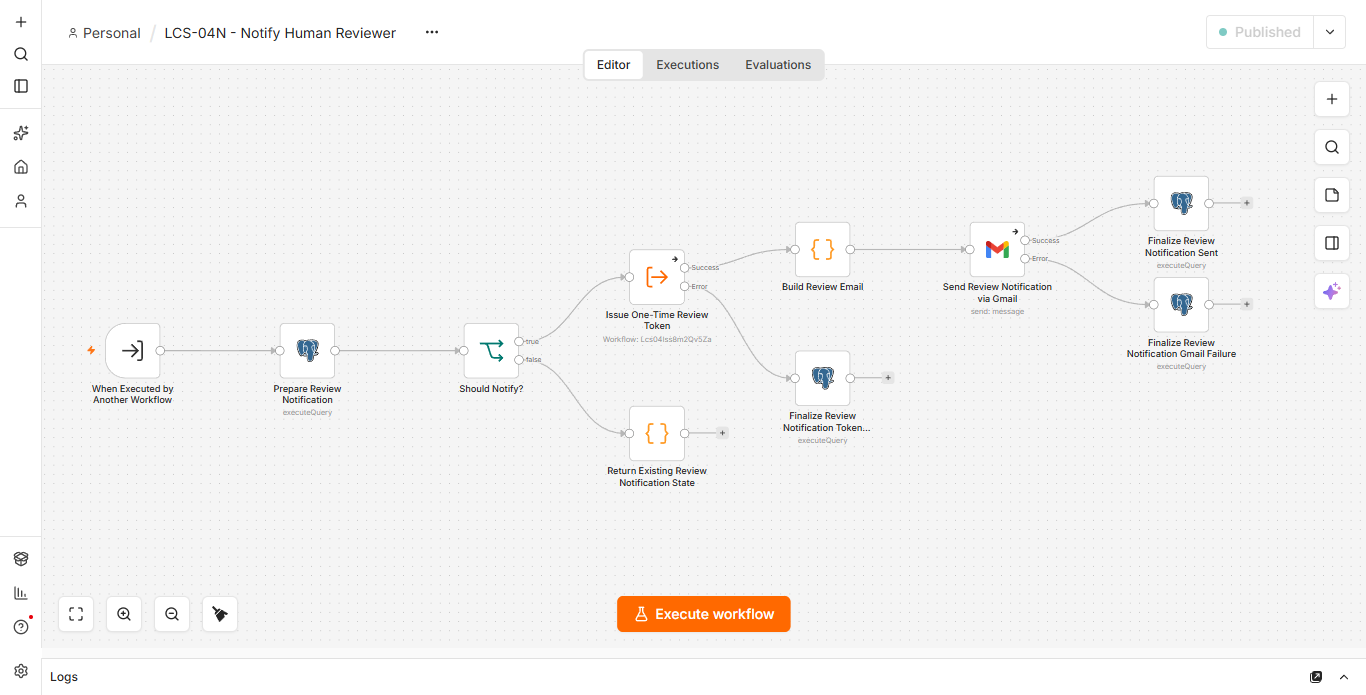
IMPLEMENTATION PROOF
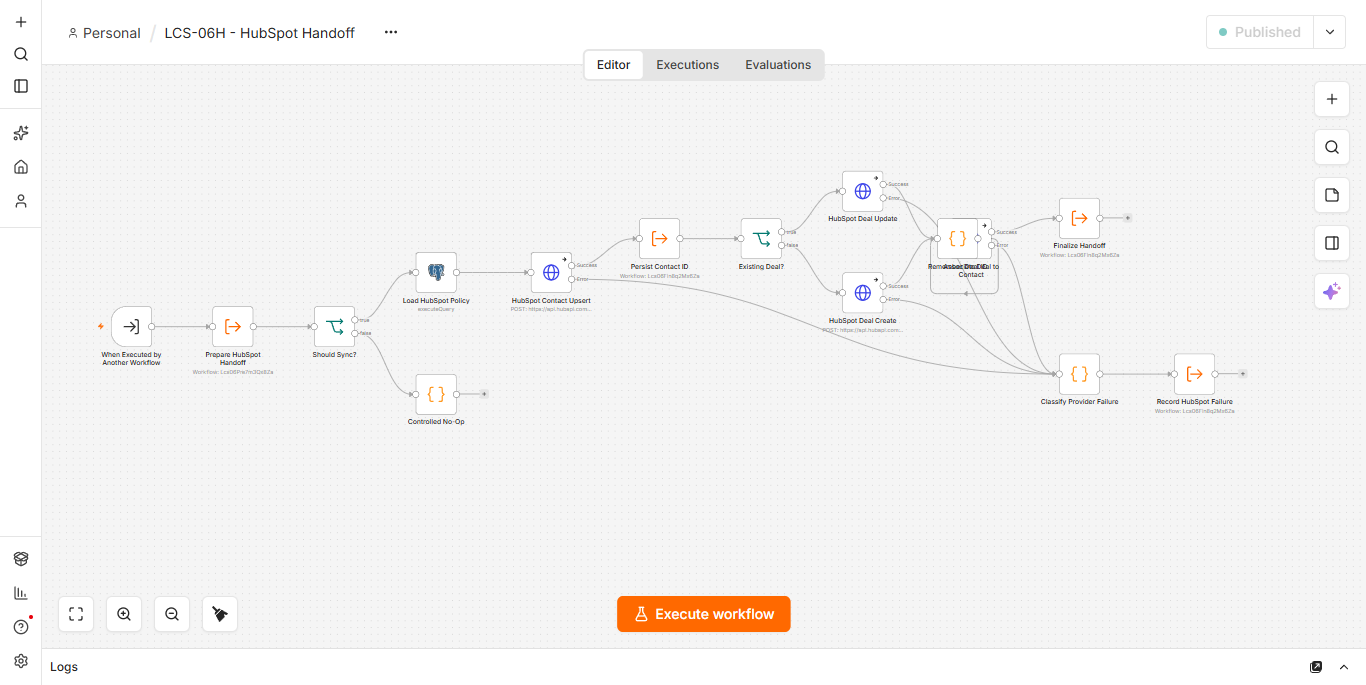
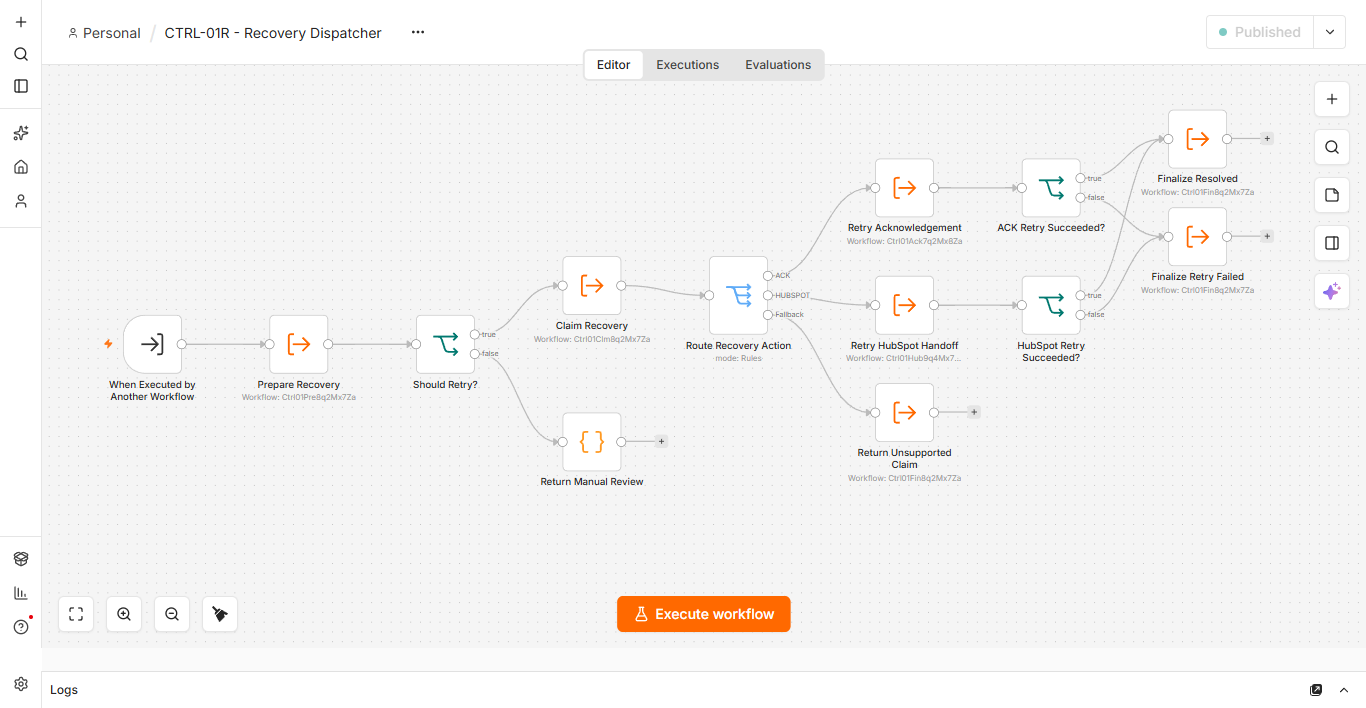
I split the workflow only where something important changes.
Related steps stay together. I split the workflow only when the owner, state, failure handling, or human decision changes.
Clear boundaries
Split the workflow where ownership, failure handling, state, or human authority changes.
Runtime tested
Checked normal operation plus duplicates, retries, failures, simultaneous-event, and recovery.
Real integrations
Gmail and HubSpot were exercised through controlled provider tests.
Saved system state
PostgreSQL keeps the system state so retries, recovery, replay, and audit do not depend on workflow memory.
What this proves: Built and runtime-tested in a controlled environment. This does not establish live-client results, production scale, or ROI.
HUMAN CONTROL INSIDE THE WORKFLOW
AI can help interpret the work. It does not get final authority.
I use AI where language and context need interpretation. People still approve the diagnosis, and fixed rules still control identity, routing, lifecycle changes, and retries.
The line I do not cross: AI does not merge identities, approve the diagnosis, change the workflow stage on its own, or decide when a failed action should retry.
WHERE THE EVIDENCE STOPS
I have built and validated the system through release readiness in a controlled test environment. I have not called it production-verified. That requires a real owner, live production setup, monitoring, controlled smoke tests, and observed operation.
EVIDENCE FROM CONTROLLED TESTING
I tested what happens when the lead journey goes wrong.
A working path is not enough. I kept test records for the cases that can create duplicate leads, incorrect decisions, unwanted follow-ups, or repeated CRM actions.
The same event was not registered twice.
In the saved intake test, a repeated submission returned a duplicate-event result rather than starting new work.
Evidence: retained intake responseThe system did not guess which lead was right.
When an email and phone number matched different leads, the result was human review—not an automatic merge.
Evidence: retained identity-resolution responseA reply stopped the next automated messages.
A controlled prospect-reply test cancelled two pending follow-ups instead of continuing the sequence.
Evidence: retained follow-up responseRecovery reused what had already succeeded.
The saved HubSpot recovery result retained existing contact and deal records. A second recovery request produced no further action.
Evidence: retained recovery result and provider test recordsEXECUTIVE EVIDENCE BRIEF
The test evidence, in one document.
A five-page summary of the system, selected test results, integration controls, and what remains unmeasured. Prepared for recruiters and technical reviewers.
WHAT I CHECK
I check six parts of the lead journey.
I look at what seems to be happening and how strong the evidence is. Those are two different things.
Capture
Do viable inquiries reliably reach someone who can act?
Qualification
Would similar opportunities be judged the same way?
Ownership
Is it clear who owns the next meaningful action?
Follow-Up
Does every viable opportunity have a clear next step and date?
Conversion & Handoff
Does control stay intact through the buying decision and into onboarding?
Visibility & Data
Can the team see what is happening without piecing the story together manually?
What the reviewed workflow appears to be doing.
How far the available evidence allows the conclusion to go.
POSSIBLE NEXT STEPS
Not every problem needs a full rebuild.
Sometimes one part needs fixing. Sometimes I need more evidence. Sometimes the real problem is outside LCS.
The evidence is not strong enough to justify a change yet.
One clear problem can be fixed without redesigning the whole journey.
The same control problem shows up across several stages, so the controls need to be redesigned together.
The sales problem may start somewhere outside the lead-to-client journey.
LIVE SYSTEM TO INSPECT
You can use the actual Velzenith experience.
These are the live front-end parts of the LCS journey. Open any one without leaving this case study.
01 · RECOGNIZELead Leakage Field Guide
See how I frame the lead-to-client problem before recommending a tool or automation.
Open live Field Guide → 02 · CHECKLead Leakage CheckTry the interactive check that helps surface where control may be weakening.
Try the live Field Check → 03 · DIAGNOSELead-to-Client SnapshotSee how the diagnostic offer turns operating evidence into a clearer next decision.
Open live Snapshot →ARTIFACTS TO INSPECT
Here is what the system actually produces.
These examples come from the test cases I use to check LCS. They are not client records.
AREAOBSERVED CONDITIONEVIDENCE
CaptureLooks controlledReasonable support
QualificationVaries in practiceReasonable support
OwnershipRelies on manual effortStrong support
Follow-UpRelies on manual effortStrong support
Conversion & HandoffRelies on manual effortStrong support
Visibility & DataVaries in practiceStrong support
MAIN PATTERNOwnership and next steps become less clear when work moves between stages.
RECOMMENDATIONLead-to-Client System Redesign
Ownership, follow-up, handoff and visibility are weak in more than one stage, so a one-stage patch would leave the same control problem elsewhere in the path.
AREACURRENT CONTROL BREAKREQUIRED CONTROL
OwnershipOwnership becomes implicit at handoffs.One visible owner at each stage and handoff.
Follow-UpNext actions can live in personal tasks.Visible next action, due date and waiting rule.
HandoffClosed-won work can arrive without required details.Required handoff information and receiving owner.
VisibilityStatus requires piecing the story together.Shared view of stage, owner, next action and handoff state.
WHAT I WOULD CHANGE
I would keep what already works.
For a real client, I would keep what fits, change what needs fixing, leave out what is not needed, and add something new only when the evidence supports it.
- Lead-to-client workflow reconstruction
- Six-area control assessment and evidence confidence
- Ownership, state, next-action and handoff rules
- Recommendation path and the boundary for implementation
- A tested reference system, including failure recovery and audit evidence
- Demand generation or offer-market-fit diagnosis by default
- Unsupported revenue-loss or conversion claims
- Automation before the operating rule is clear
- Production claims before the system has actually been observed live
- Final diagnostic or report approval without human judgment
WHAT THIS REQUIRED
What I had to get right.
Commercial Systems Design
Treated the lead journey as one connected flow, not a collection of CRM stages.
Workflow Design
Made the owner, next action, handoff, exception, and completion rule explicit at each stage.
Fact-Based Review
Kept what I could see separate from what I could actually prove.
AI with Human Review
Used AI where interpretation helped, while keeping diagnosis and approval with a person.
Implementation Control
Only built what the diagnosis supported. An existing module is not a reason to use it.
AI & Automation Implementation
Built the working flow in n8n, with PostgreSQL holding system state and Gmail and HubSpot handling real provider actions.
Validation & Controls
Tested the awkward cases too: duplicates, conflicting identities, simultaneous events, provider failures, retries, and recovery.
CURRENT EVOLUTION
The next proof has to come from live use.
The reference system is runtime-tested.Next: adapt it to a real client workflow, finish the production setup, and learn from live use before making performance claims.
Does your lead process rely too much on someone remembering what happens next?Discuss a Project →← View all selected work