A signal from normal work: overdue, failed, blocked, unowned, missed, or otherwise outside the expected state.
OPERATIONS CONTROL
Operations Control System
Makes overdue, failed, blocked, or unowned work visible, gives it a clear owner, and keeps escalation, recovery, and closure under control.
WORKING SYSTEMTESTED · RELEASE VERIFIED
I built OCS for operational problems that should not disappear between tools and people. It takes problems such as overdue work, a failed workflow, a missed handoff, or a missing owner and gives them a clear owner, acknowledgement, escalation path, recovery path, closure, and history.
CURRENT EVIDENCE
Designed: complete. Built: complete. Tested: complete. Delivered: not yet complete. Measured: not yet complete
I designed, built, systematically tested, released, and documented the internal reference system across intake, qualification, duplicate protection, assignment, acknowledgement, timing, escalation, action, recovery, closure, reopening, audit, health, reporting, security boundaries, rollback, and change management. Validation included 70 controlled checks plus a 10-of-10 authenticated end-to-end release test.
Claim boundary: This proves the reference implementation and its controls work in the tested internal environment. It does not prove enterprise scale, real client adoption, sustained production volume, ROI, time savings, or P3 maturity.
EXECUTIVE SNAPSHOT
A control system for operational problems that should not disappear between tools and people.
OCS is for work where an overdue task, failed workflow, missed handoff, missing owner, or blocked item needs more than an alert. It gives the problem a clear owner and keeps acknowledgement, escalation, recovery, and closure visible until the work is done.
OCS checks whether it really needs attention, finds the right owner, tracks acknowledgement, time, escalation, action, and recovery.
A problem that has a clear owner, stays visible, can recover from failure, and closes without losing its history.
WHEN YOU WOULD USE IT
When alerts exist, but responsibility still falls through the cracks.
WHAT OCS DOES
It turns an operational problem into work someone clearly owns.
Check where the problem came from, confirm that it really needs attention, and stop repeated events from creating duplicate work.
Assign the right owner and record whether they have actually accepted responsibility. Sending a notification does not count as acknowledgement.
Track how long the issue has been waiting and escalate when its deadline, severity, or ownership rule requires it.
Keep technical recovery, business resolution, closure, and reopening separate so fixing the workflow cannot hide an unresolved business problem.
THE OPERATING PROBLEM
An alert can tell you something happened. It cannot prove the problem is controlled.
I kept finding the same problem: teams can have dashboards, notifications, and automations while ownership, acknowledgement, escalation, and closure still depend on memory or chat.
OCS was designed around that gap: detect the problem, give it an owner, make sure it is acknowledged, escalate when needed, and keep it visible until it is resolved and closed.
Why this matters
Visibility without responsibility still leaves the business exposed.
If nobody clearly owns the problem, accepts it, works it, and closes it, the alert itself has not solved the operational problem.
MY ROLE
I designed how OCS handles a problem from detection to closure.
I defined how OCS detects a problem, gives it an owner, records acknowledgement, tracks deadlines, escalates when needed, handles failures, and decides when the issue can safely close. Then I built, tested, released, and documented the reference system.
SYSTEM FLOW
The issue moves only when the next check passes.
The steps are simple on purpose. The important part is knowing who owns the issue, how long it has been waiting, what happens when something fails, and what has to be true before it can close.
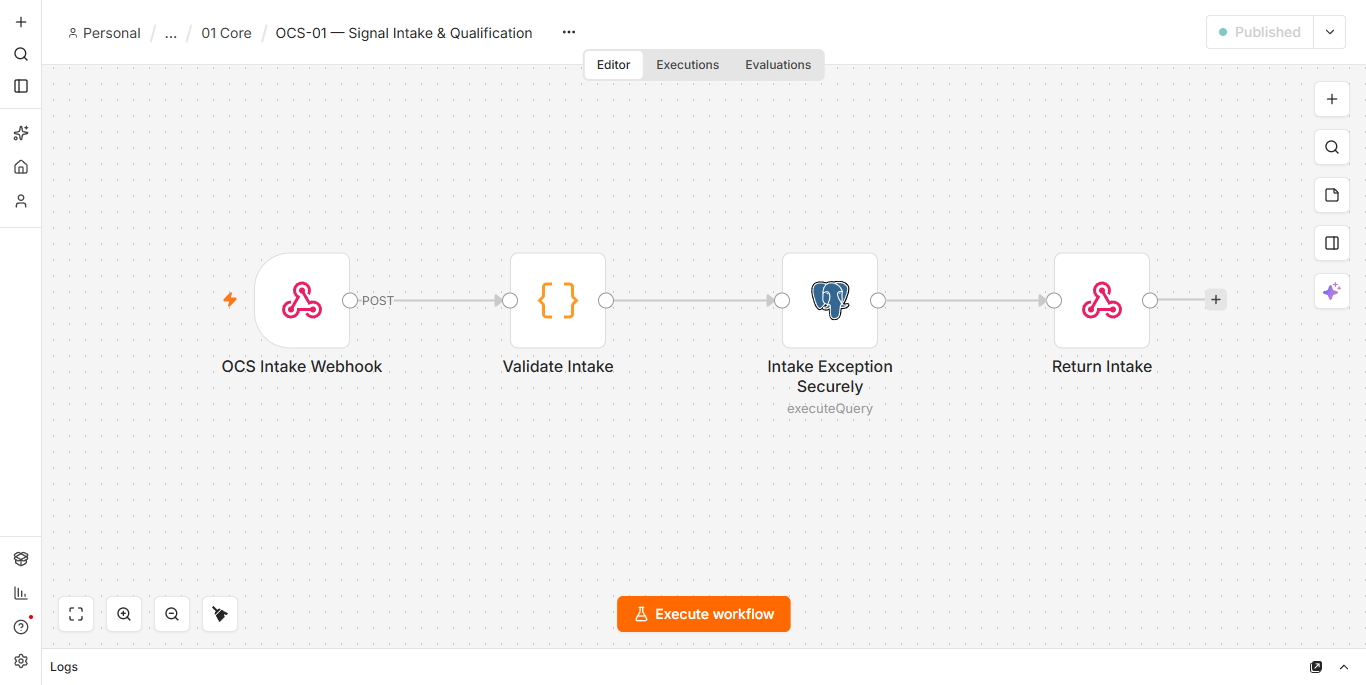
The workflow receives the event, checks the input, passes it to the controlled intake function, and returns the result without letting repeated events create uncontrolled duplicate work.
CONTROL BOUNDARIES
Several things that look similar are deliberately kept separate.
Notification is not ownership
A message can be delivered without anyone actually accepting responsibility. OCS records assignment and acknowledgement separately.
Recovery is not resolution
A retry can fix the automation while the business problem is still open. Those states stay separate.
The original system still owns the business record
OCS tracks the problem around the work. It does not replace the CRM, finance system, HR system, project tool, or support system that owns the original record.
No open issues does not always mean everything is healthy
OCS checks system health separately, so a failed monitor or workflow cannot make the system look healthy simply because no new problems were recorded.
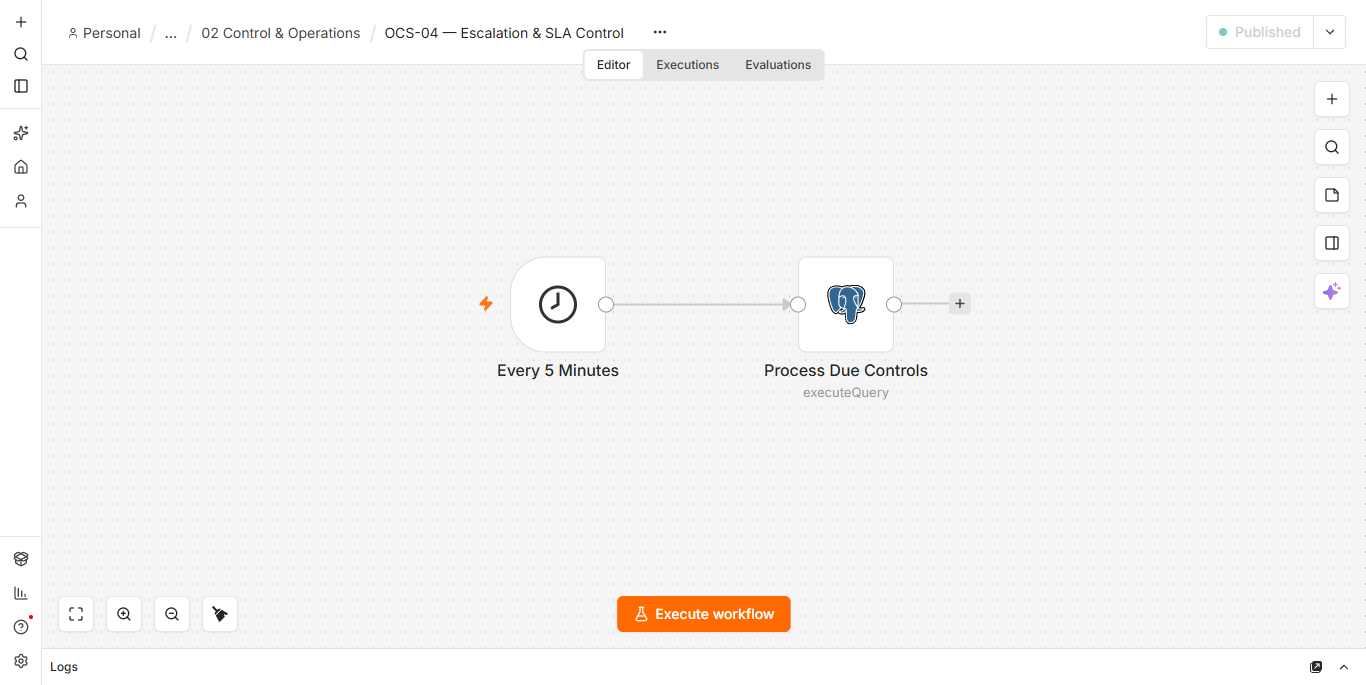
Every five minutes, OCS checks due acknowledgement and resolution controls so overdue work can be escalated and kept visible.
WHAT I TESTED
The proof includes the failure paths, not only the happy path.
The reference build was validated with controlled synthetic data. The evidence shows the system and its controls work in the tested environment; it does not prove live business performance or production scale.
Complete system path
Tested the full path from a new issue through ownership, acknowledgement, action, resolution, closure, reopening, health checks, and reporting. The release test passed 10 of 10 checks.
Rules + permissions
Tested invalid state changes, actions by the wrong user, conflicting updates, assignment rules, acknowledgement, and closure requirements.
Failures + recovery
Tested temporary failures, repeated failures, isolated failed work, delayed processing, and recovery that cannot overwrite newer information.
Duplicate protection
Tested repeated events and repeated actions so the same issue does not create uncontrolled duplicate work.
System health
Tested that workflow failures stay visible and cannot be mistaken for “nothing is wrong.”
Reuse across different operations
Tested the same core lifecycle with Operations and Finance rules while keeping each department’s severity and review requirements separate.
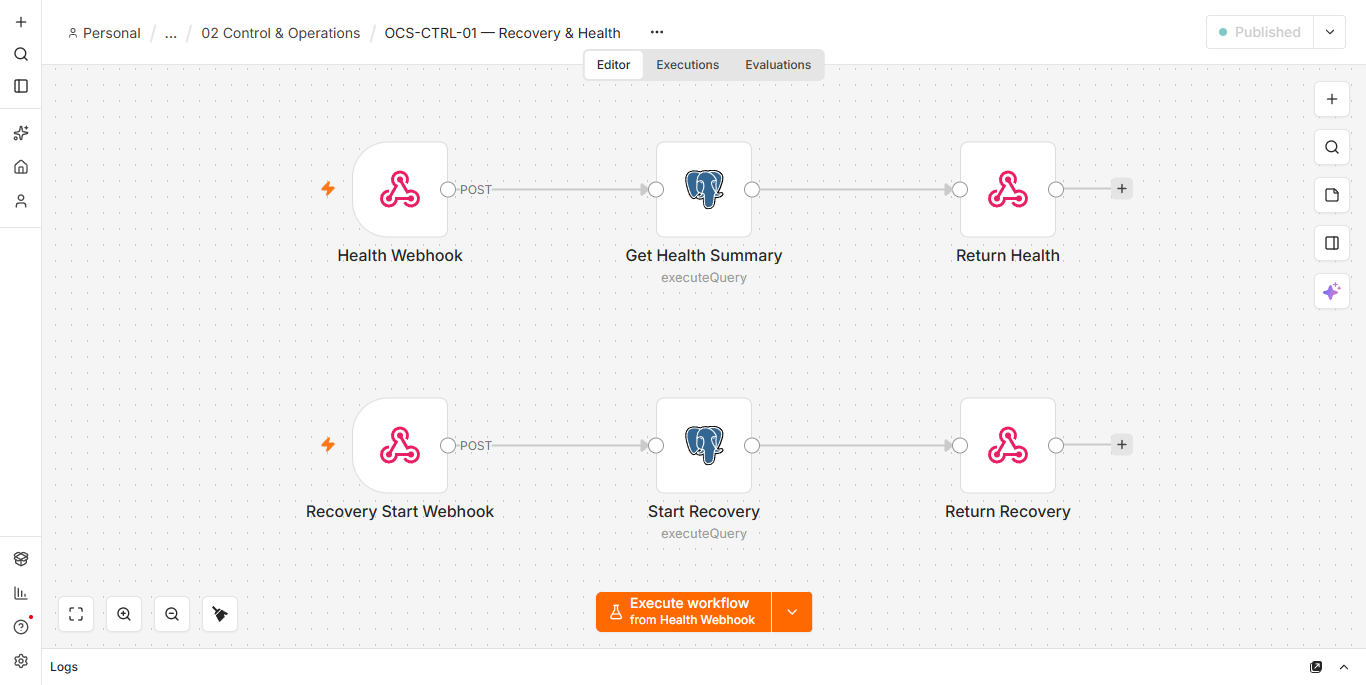
The control workflow exposes system health and recovery separately from the business exception, so processing failure stays visible.
SYSTEMATIC VALIDATION70 CHECKS
END-TO-END RELEASE TEST10 / 10 PASS
HEALTH AT RELEASEHEALTHY
Claim boundary: this is a validated internal reference implementation. It does not prove enterprise scale, client adoption, ROI, time savings, or sustained production volume.
IMPLEMENTATION
The workflow coordinates the work. The database protects the state.
I used n8n for intake, routing, timers, orchestration, recovery, and reporting. PostgreSQL/Supabase keeps the official OCS record and enforces important state changes. That means a workflow mistake cannot simply skip the rules that protect ownership, escalation, recovery, or closure.
Intake · routing · acknowledgement · escalation · recovery · reporting
Problems · policy · ownership · lifecycle · audit · processing · recovery · health
Review · acknowledge · act · resolve · close · reopen · inspect history
WHAT THIS REQUIRED
What I had to get right.
Operational Diagnosis
Found that the real problem was not a lack of alerts. It was the lack of clear ownership and a consistent path from detection to closure.
Business Systems Design
Kept the original business record, the operational problem, workflow processing, recovery, and system health separate so one could not hide or overwrite another.
Workflow Architecture
Split intake, assignment, acknowledgement, escalation, closure, recovery, and reporting into clear responsibilities.
Validation & Controls
Designed tests before the build and validated success, failure, permissions, replay, conflicting updates, and recovery behavior.
Documentation & Handoff
Created release, monitoring, runbook, and change-management records so the system can be operated and changed safely.
Systems Integration
Used n8n with PostgreSQL/Supabase while keeping the official OCS record and important state rules at the database boundary.
CURRENT EVOLUTION
The core system is validated. The next thing worth proving is how it holds up in real use or when adapted to a different department.
The core system is validated and released for controlled internal use. The next thing worth proving is how it performs in real use or when adapted to a different department—not by adding more features to the reference build.
Need better control over operational problems that fall between tools and people? Discuss a Project → ← View all selected work