An RFP, questionnaire, form, or requirement list that needs accurate answers.
RESPONSE OPERATIONS
Evidence-Grounded Response System
Helps teams answer RFPs, client questionnaires, vendor forms, and capability requests using approved company information.
WORKING SYSTEMTESTED · RELEASE VERIFIED
I built EGRS to take a request with many questions, find approved proof for each one, draft only what the proof supports, and send uncertain answers to a person for review.
CURRENT EVIDENCE
Designed: complete. Built: complete. Tested: complete. Delivered: not yet complete. Measured: not yet complete
I built and tested the reference system from request intake through breaking the request into questions, finding approved company information, checking what each answer can safely say, human review, packaging, recovery, health monitoring, and operator notifications. The acceptance set passed 13 of 13 cases, and the notification path was checked through Gmail.
Claim boundary: This proves the reference implementation and its controls were built and validated. It does not prove client adoption, production scale, proposal win rate, time savings, revenue impact, or ROI.
EXECUTIVE SNAPSHOT
A controlled way to answer business questionnaires without guessing.
A prospect, client, or procurement team sends an RFP, questionnaire, vendor form, or capability request. EGRS helps turn those questions into answers the business can support with approved company information.
The system finds approved company information for each question and checks what that information actually supports.
A draft backed by approved information, with uncertain or sensitive answers sent to a person for review.
WHEN YOU WOULD USE IT
When a business has to answer a lot of questions accurately.
EGRS is useful when the answer already exists somewhere in the business, but someone still has to find the proof and make sure the response does not overstate it.
THE OPERATING PROBLEM
A good-sounding answer can still say more than the proof allows.
Important information can be spread across resumes, project files, standards, past work, and other approved sources. Before answering a structured business request, someone still has to find the proof, decide what it actually supports, and make sure the final response does not overstate it.
I built EGRS around that decision rather than around the writing step.
Why this matters
Fluent writing is not the same as a defensible claim.
If the supporting information is missing, partial, conflicting, or outside what the system is allowed to decide, the response should show that limit instead of smoothing it over.
WHAT EGRS DOES
It turns a long request into answers the business can actually support.
Takes an RFP, questionnaire, form, or list of requirements and separates the questions that need answers.
Looks through approved company information for proof related to each question.
Shows whether the proof fully supports the answer, partly supports it, conflicts with it, or is still missing.
Builds the response from approved information and sends uncertain or sensitive items to a person for review.
WHY NOT JUST ASK AI?
The model can help write the answer. It should not decide what the business can prove.
The answer may sound convincing even when the business cannot prove it.
AI helps interpret and write. Approved company information and review rules decide what can be said.
SYSTEM FLOW
Every answer has to be supported before it can reach the final response.
The system breaks the request into questions, then checks the approved information before an answer can move toward approval.
MY ROLE
I designed the rules for what the system can say, what AI can help with, and what still needs a person.
I defined how requests are split, which company information is allowed, how well it supports each answer, what answers need checking, when a person must review, and how failed work is retried, recovered, monitored, and released. Then I built and tested the system.
QUESTION → APPROVED INFORMATION
Missing information is not the same as a negative answer.
EGRS keeps more than a simple match/no-match result. A question can be fully supported, partly supported, contradicted, or genuinely unknown.
SUPPORTEDThe approved information is strong enough to support the answer.
PARTIALLY SUPPORTEDRelevant information exists, but it does not fully support the answer.
UNSUPPORTEDThe available information does not support the answer.
CONTRADICTEDAvailable information conflicts with the answer the request would need.
UNKNOWNThere is not enough approved information to answer safely.
CORE RULE No approved information found ≠ proof that the answer is false.
The system keeps the gap visible and sends the question to the right next step based on the available proof and who is allowed to decide.
AI + HUMAN REVIEW
AI can help understand the question. It does not decide what the business is allowed to say.
Approved information only
The response can use only sources the business has allowed the system to rely on.
AI helps; rules still control
AI helps read, match, compare, and draft. It does not decide what the organization is allowed to claim.
Check the answer before approval
A polished sentence is not enough. The response still has to trace back to supporting information.
A person decides when needed
Uncertain, conflicting, sensitive, or approval-dependent answers stop for review.
Recovery stays explicit
Failed or incomplete questions can be retried or recovered without quietly duplicating the whole request.
The work stays visible
Processing, review, notification, retry, and recovery states can be checked instead of disappearing inside the automation.
- Understanding the question
- Finding relevant approved information
- Comparing the information with the question
- Drafting the response
- Flagging possible overstatements
- Approval of company information
- What the business treats as true
- Permission to make sensitive statements
- Final response approval
- Permission to submit
WORKING IMPLEMENTATION
I split the workflow into parts so one failure does not hide the rest of the work.
Intake, information checking, drafting, review, packaging, retry, recovery, monitoring, and notifications each have a clear job. I kept those parts separate instead of forcing the whole process into one automation.
Capture the request and split it into questions that can be checked one by one.
Find approved company information, check how well it supports the question, and keep gaps or conflicts visible.
Draft the response, then check that it does not say more than the proof supports.
Pause uncertain or sensitive questions when a person needs to decide.
Prepare the final response for a person to submit. The system does not submit it on its own.
Retry, health checks, audit records, and operator notifications stay available across the workflow.
INSIDE THE ACTUAL BUILD
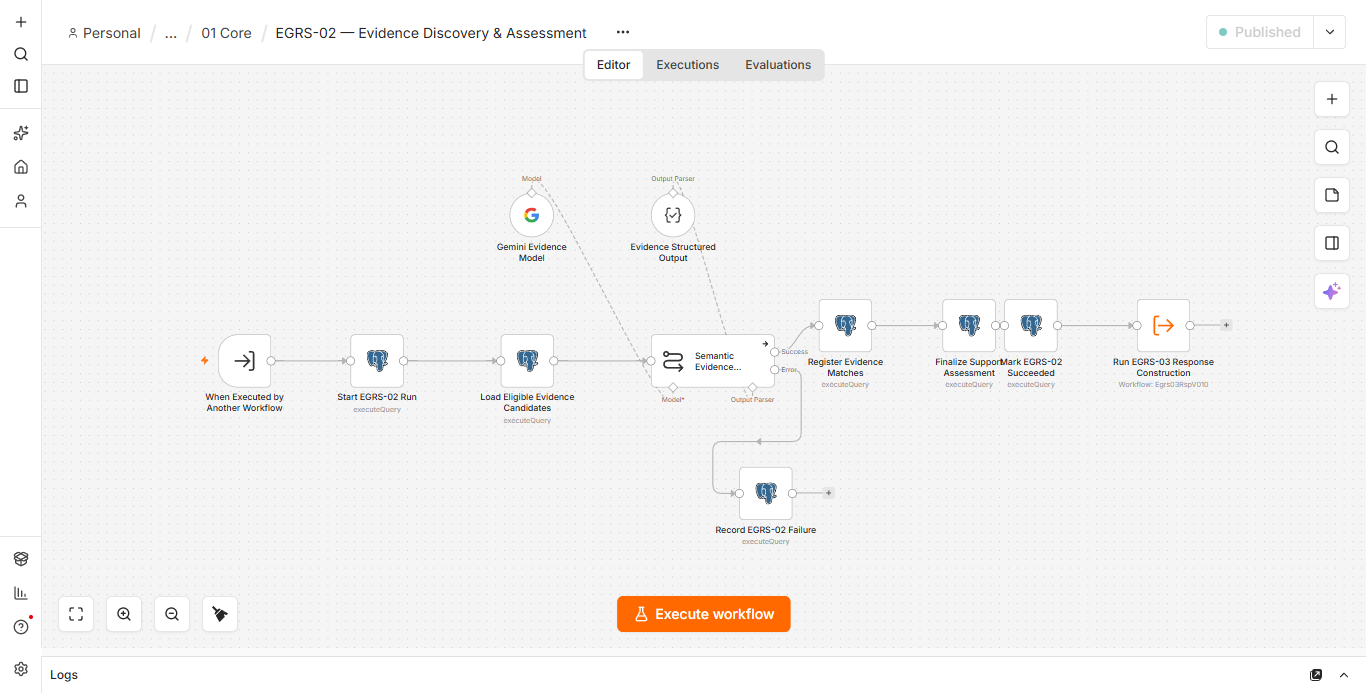
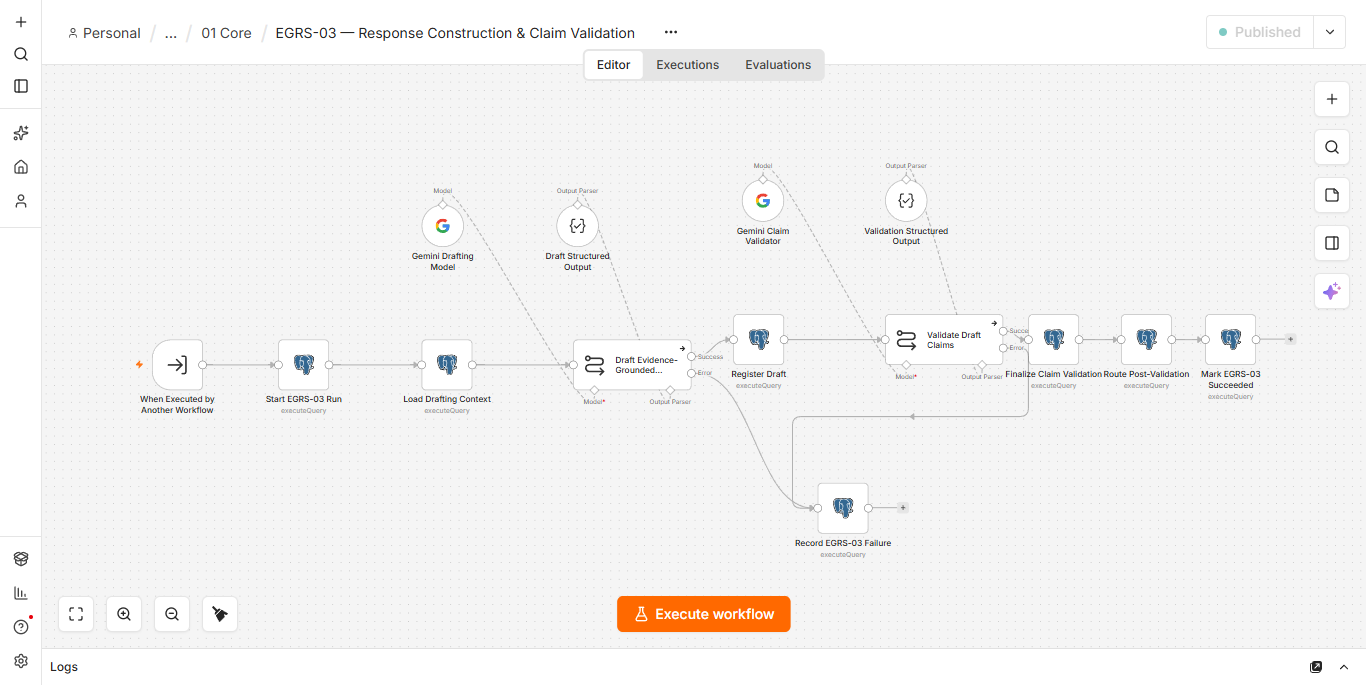
The system is implemented in n8n, not just mapped on paper.
These screenshots are shown only where they prove a specific system responsibility. The workflow is the proof; n8n is simply the implementation tool.
Actual n8n workflow · shows the path for finding approved information and checking what it supports, while keeping gaps and conflicts visible.
Actual n8n workflow · shows the draft and unsupported-answer checks that run before the work can move to human approval.
VALIDATION
I did not only test the happy path.
I also checked what happens when approved information is incomplete, a question needs a person, or part of the workflow fails.
13 / 13 defined test cases
Every defined acceptance case passed in the controlled test run.
Five answer states
The system keeps supported, partial, unsupported, contradicted, and unknown outcomes separate instead of forcing a yes/no answer.
Unsupported-answer check
Drafted answers are checked against the supporting information before they can move toward approval.
Human review where needed
Answers that need judgment or approval are sent to a person instead of being silently approved.
Retry + recovery
A failed question can be retried or recovered without restarting or duplicating the whole request.
Visible failures
Health checks and monitoring make stuck or failed work visible.
Real notification path
The operator notification path was smoke-verified through Gmail.
Release readiness
I kept the release, recovery, and change records with the tested system instead of stopping at a successful demo.
ARTIFACTS TO INSPECT
You should be able to see why an answer was written the way it was.
These are representative structures from the validated reference system. They do not expose private client data or credentials.
QUESTIONCan the business show documented workflow automation capability?
SUPPORTSUPPORTED
APPROVED INFORMATIONImplementation record
WHAT WE CAN SAYDescribe the demonstrated implementation; do not imply scale or outcomes the proof does not establish
REVIEW REASONThe information is relevant but incomplete
ANSWER STATEPARTIALLY SUPPORTED
NEXT STEPHUMAN REVIEW
AUTOMATIC ANSWERBLOCKED
ACCEPTANCE13 / 13 PASS
RECOVERYAVAILABLE
MONITORINGACTIVE
NOTIFICATION PATHGMAIL VERIFIED
EVIDENCE BOUNDARY
I can prove the system was built and validated. I cannot claim business results I have not observed.
This version passed its defined acceptance cases, includes retry, recovery, and monitoring controls, and had its Gmail notification path smoke-verified. I am not claiming proposal wins, faster response times, client adoption, revenue impact, production scale, or ROI.
- Requirement-by-requirement evidence checking
- Responses grounded in approved evidence
- Clear human review boundaries
- Checks for unsupported or overstated claims
- Retry, recovery, monitoring, and release controls
- Proposal or RFP win rate
- Measured time savings
- Live client adoption
- Production-scale throughput
- Revenue impact or ROI
WHAT THIS REQUIRED
What I had to get right.
Question Breakdown
Turned a broad structured request into individual questions that can be checked independently.
Approved-Information Controls
Kept the proof, gaps, conflicts, and uncertainty attached to each question instead of hiding them in the draft.
Requirement Matching
Checked how well approved company information supports each question instead of relying on a generic similarity score.
AI with Human Review
Used AI to interpret, match, draft, and flag possible overstatements while keeping final approval with people and rules.
Workflow Design
Separated intake, information checking, drafting, review, packaging, retry, and recovery so each part has a clear job.
Validation & Controls
Tested acceptance behavior, unsupported claims, review boundaries, retries, recovery, notifications, and release readiness.
CURRENT EVOLUTION
The system is validated. The next proof has to come from real use.
The system is validated and release-verified. Next: connect it to a real organization’s approved knowledge, review rules, and response process, then measure what actually happens before making business-performance claims.
Need a response system that stays inside the evidence? Discuss a Project → ← View all selected work